
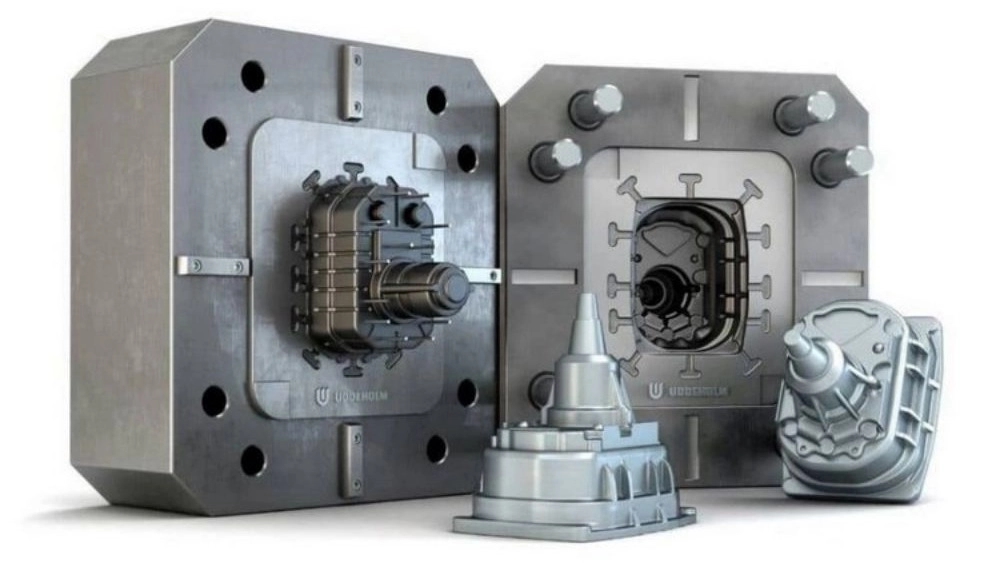
Diecast mold, which is also called pressure casting, is one of the most widely used methods in the manufacture and production of metal parts in various industries. Unlike the plastic injection mold method, which is used to produce plastic parts, but the die cast mold is used to produce metal parts. In the diecast method, metal parts are produced according to the general principles of casting, and at first, after the material is completely melted, it is injected into the mold and the material is frozen from liquid to solid. Today, a very diverse range of aluminum parts are made by die-cast method, which helps to reduce the weight of the production parts. The complexity of such parts makes the production of die-cast molds to be entrusted to a skilled and experienced team, which usually has a high production cost. In this method, the high mechanical and thermal stresses that are created in the mold parts should be calculated and steel that is resistant to all these stresses should be used to prevent premature cracking of the mold parts as much as possible.
What is Dykast (Pressure Casting)?
The die-cast mold is a closed chamber into which the molten metal is injected under pressure and high temperature, then it cools quickly so that the solidified piece becomes sufficiently rigid and can be removed from the mold. This process uses a cold or hot chamber production technique that relies on high pressure to inject molten metal at speeds of 60 to 100 miles per hour (96 to 160 km) into a reusable steel mold, which is ultimately It leads to making a diecast mold. In this method, parts from a range of durable non-ferrous metals such as zinc, magnesium, aluminum and a set of composite materials are produced.
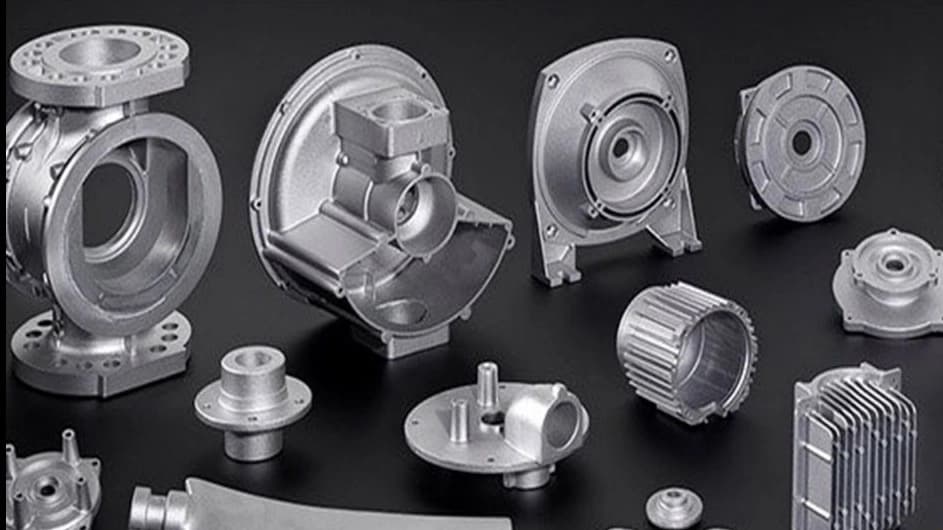
Dyka Parts and Products Separation Lines
One of the most important design parameters for diecast molds is deciding on the type of parting line that splits the part and creates a contact surface between two or more components. Where the designer places this line depends on the geometric shapes and tolerances of different surfaces. The designer has two choices, either a straight parting line or a broken parting line. You should try to design parts with a straight parting line because it is the least expensive option in terms of tooling cost. When deciding on the parting line, the designer should consider the following factors:
When deciding on the separation line, the designer should consider the following factors:
Customer Order – Usually the specifications of the customer's part or product make the placement of the parting line challenging. Mandatory customer requirements also become an issue
Estimating mold costs – A straight parting line can reduce tooling costs. However, in some cases, it will be more economical to design a broken separator line because otherwise the features of the part in question will force you to start a new line, which will cause an overhead cost.
Machining and Finishing – Most parts require post-production machining. Parts of the piece need finishing work and machining. In addition, this part should not need to be beautiful because the effects of the final payments will be visible on the piece.
Molten metal flow - The quality of molten metal injection depends on the proper location of the heart inlet. The mold input should be drawn on the dividing line. This has three advantages. First, it determines whether the casting mold is properly filled with molten metal. Second, under high pressure casting, the injection or filling mechanism can push the metal into the casting to prevent the part from shrinking during solidification, and third, it can also be paid by polishing the parting line of the mold entrance.
Cores – The position of the cores (the cores create holes in the part) determine where the parting line is located. The designer must consider the location of the core as well as the diameter and length of each core for each hole required in the casting.
Melt flow is one of the most important considerations during the die-cast mold design process. If the mold is not filled accurately, it will lead to defects in the output part. These defects appear in the form of surface lines or air holes in the form of internal mace on the part, which reduces the strength and beauty of the part.
Also, the designer should pay attention to the springs that remove the part from the mold in his design. Blades should be designed to leave minimal marks on the part. One of the advantages of Pran is to prevent the part from bending. The effects of the spring pin on the parts are compressed or embossed in about 0.3 mm. The diameter of the spring pin markings will vary depending on the size of the casting.
Plastic molding
Plastic molding is a process in which molten plastic materials are injected under pressure into a cold mold, and after cooling and solidification, the desired plastic piece is obtained. This method is very suitable for the mass production of plastic parts with complex and diverse shapes.
The benefits of plastic molding:
Mass production: it is possible to produce a large number of identical parts quickly and economically.
The complexity of the shape of the parts: the ability to produce parts with complex shapes and many details.
Variety of raw materials: the possibility of using different types of plastic materials with different properties.
High accuracy: The dimensions and shape of the manufactured parts are highly accurate.
Light weight: plastic parts are usually light weight.
Plastic molding applications:
Production of car parts Production of electronic components Toy production Packaging production Production of household appliances
Dykast
Diecast or pressure casting is a process in which molten metal is injected under high pressure into a cold mold, and after cooling and solidification, the desired metal piece is obtained. This method is suitable for producing metal parts with high strength and precise dimensions.
The benefits of the Dycast:
High resistance: Diecast parts usually have high mechanical and thermal resistance.
Accurate dimensions: The dimensions of diecast parts are highly accurate.
Mass production: It is possible to mass produce metal parts.
Smooth and uniform surface: The surface of diecast parts is usually smooth and uniform.
Dycast Applications:
- تولید قطعات خودرو
- تولید قطعات الکترونیکی
- تولید اسباببازی
- تولید بستهبندی
- تولید لوازم خانگی
The selection between plastic and diocast molding depends on the following factors:
Type of material: If the part in question needs high resistance, diecast is a better choice. Otherwise, plastic molding is more suitable.
Part shape: If the part has a complex shape, plastic molding is a better choice.
Production volume: For mass production, both methods are suitable.
Cost: Plastic molding is usually less expensive.
نظرات و تجربیات شما
دیدگاه شما چیست؟
با ثبت امتیاز خود، به ما در تولید محتوای بهتر کمک کنید.